
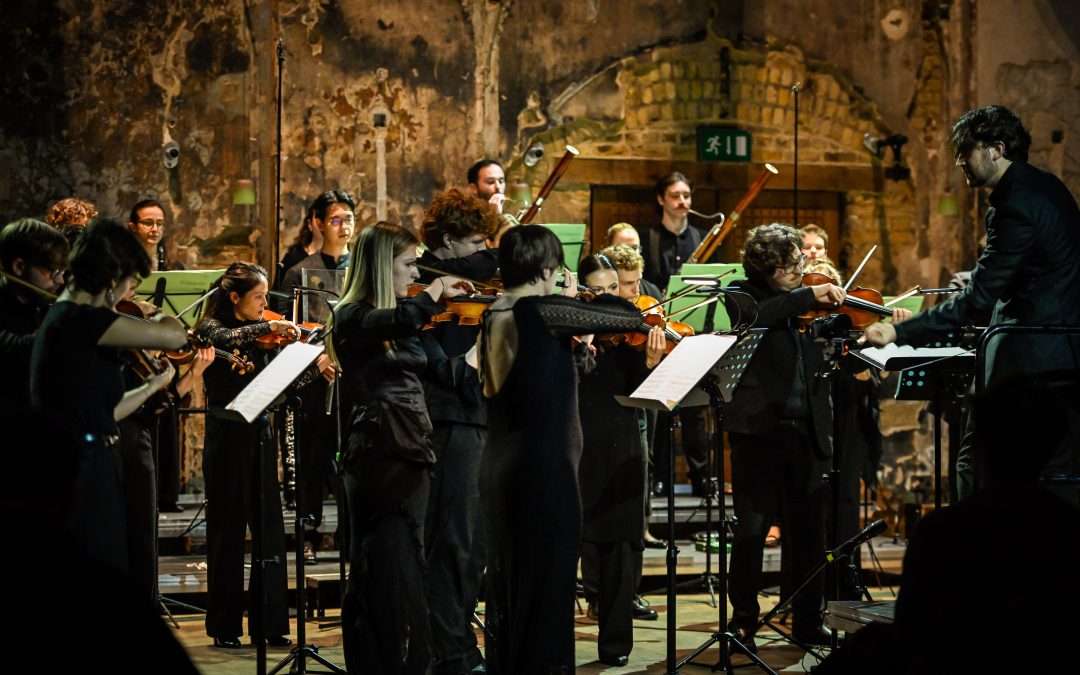
Oliver Cope (r), conducting the Chromatica Orchestra in Shostakovich’s Ninth Symphony, photo (c) Monika Jakubowska 2026
Sarang Seohyun Kim, violin; Chromatica Orchestra / Oliver Cope
Battersea Arts Centre, London, October 14, 2026
I am going to stick my head above the parapet here and declare that Bernard Herrmann’s Psycho (1960) is the finest film score ever penned. Scored for strings alone (without even a harp) to match the monochromaticism of Hitchcock’s film, it is both extraordinarily expressive, superbly matched to the action on screen, and crucial to the film’s success. “Thirty-three percent of the effect of Psycho was due to the music,” Hitchcock acknowledged (as quoted in Alexandra Coghlan’s excellent programme note). “And probably more if you ask Bernard Herrmann.”
Realising the intrinsic value of his music, in 1968 Herrmann created a concert suite (again for string orchestra) entitled Psycho – A Narrative, broadly following the sequence of events in the film, and it was this that provided the electrifying opening item of Chromatica Orchestra’s 2026-27 season, the first with inaugural Principal Conductor Oliver Cope, who is clearly a name to watch. Cope phrased and paced the score with compelling confidence and assurance, drawing secure, vivid playing from his youthful ensemble (as an orchestra, Chromatica are just two years old with most of its players in their twenties). The infamous stabbing chords – which Hitchcock had initially not wanted but realised his error on hearing Herrmann’s score – were despatched for all their worth and shock value but it was the driving rhythms and discomfortingly comforting main theme that struck home.
After an engaging, if overlong, commentary on the music of the first half by leader Maren Bosma, the main orchestra (now with harp) was joined by 18-year-old violinist Sarang Seohyun Kim (on her birthday). Chromatica have worked with a stellar array of soloists to date – including Francesca Dego, Julian Bliss, Ben Goldscheider – and Kim is worthy of that company. She gave in a quite enchanting account of Korngold’s Violin Concerto (1945), his first post-WW2 concert work, assembled from passages in four film scores of the 1930s and ’40s. Kim’s total focus, impeccable intonation and wonderfully expressive lines were the concert’s highpoint for most of the audience, reflected by their rapturous applause. Sarang Kim is also one to watch and astonished all with a jaw-dropping encore of Ysaÿe’s Sonata Ballade in G minor.

Sarang Seohyun Kim captivating the audience in Korngold and Ysaÿe. Photo (c) Monika Jakubowska 2026
As so often with younger orchestras, there is a fierce enthusiasm to Chromatica’s playing, whether in Herrmann’s coruscating cinematic score, Korngold’s lusher accompaniment, or especially Shostakovich’s by turns snarky, satirical, desolate, uproarious Ninth Symphony, like Korngold’s Concerto, composed in 1945. Stalin had hoped for a victory epic to complete the wartime trilogy with the Leningrad and Eighth Symphonies with himself as the central Hero. But although Shostakovich started just such a work, as he explained later (quoted in Testimony): “They wanted a fanfare from me, an ode… Everyone praised Stalin and now I was supposed to join in this unholy affair… But I couldn’t write an apotheosis to Stalin, I simply couldn’t. I knew what I was in for when I wrote the Ninth.”
Whatever one thinks of Volkov’s book, that comment does ring true. In a prefatory, illustrated talk immediately prior to the performance, Oliver Cope, who started out in music as a harpist, laid out some of the key aspects to listen for, given that the Ninth is one of Shostakovich’s less familiar symphonies. His view of the recurring two-note trombone motif in the opening Allegro as a KGB rallying cry was an interesting thought (I have always previously heard it more as raspberry-blowing at Stalin), but his suggestion that the succeeding Moderato was coloured by the atomic bomb-blast at Hiroshima (the movement was begun that day) was less convincing: August 1945 was too early to appreciate the full impact of the Bomb and the music is too … winsome, not nearly tragic enough.

The KGB brass in full cry. Photo (c) Monika Jakubowska 2026
That said, the performance itself was thrilling, involving and totally convincing on its own terms. The wind solos in particular were finely drawn, and the heavy brass had a ball. The fullish audience did seem a touch nonplussed, truth be told, if the slightly cooler applause was a guide, but then as Cope stated in the programme book: “If someone leaves having experienced something they weren’t quite expecting … then I think we’ve done something right.” They certainly had; indeed, orchestra and conductor barely put a foot wrong. Bravo!
Chromatica’s Surface and Shadow is to be broadcast at a later date