
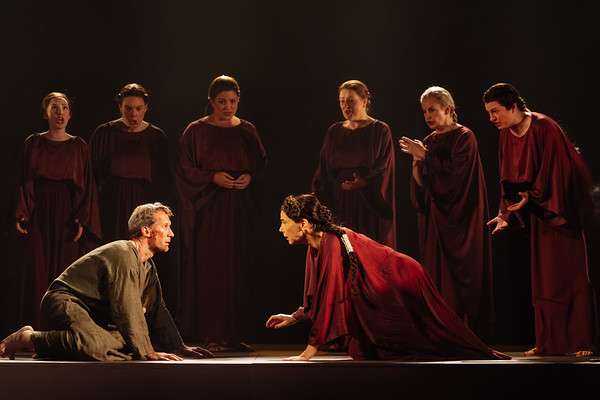
Brother and sister reunited: Jacques Imbrailo, Christine Rice, ENO 2026. Photo © Helen Murray.
Gluck: Iphigénie en Tauride
ENO / David Bates
The Coliseum, London, November 6, 2026
While ENO’s founding principle was staging opera in English, there have always been exceptions: Oedipus Rex (in Latin) and L’Orfeo (in Italian) in the early 1960s, John Buller’s visceral Bakxai (in Greek) in 1992. Lyndsey Turner’s new production of Gluck’s penultimate opera, Iphigénie en Tauride, is another such, sung in the original French of Nicolas-Francois Guillard’s 1779 libretto though, as in the precursors listed above (except Buller’s), for no readily discernible reason. That said, the language proved no barrier to the story-telling.
The scenario is relatively straightforward for one set within the House of Atreus. Iphigenia, supposedly sacrificed by her father, Agamemnon, to summon the winds to waft his fleet to Troy, was herself spirited away from the altar at the last second by the goddess Diana and installed as her Chief Priestess in a Scythian temple in Crimea. Two decades later, knowing nothing of Clytemnestra’s retributive murder of Agamemnon and their son Orestes’ murder of his mother and her lover in return, Iphigenia’s peaceful existence ends when two shipwrecked sailors are condemned to death by the local tyrant, Thoas, towards the end of Act 1. But in Act 4 it transpires that that one is none other than Orestes, himself. The denouement threatens stark tragedy: divine intervention proves otherwise.
Writing in the programme book, Richard Bratby commented how Iphigénie en Tauride, the culmination of Gluck’s experimentation with operatic form in the previous decade, produced ‘less of a “reform” of Baroque opera seria … than an overdue course correction’, providing the link between Monteverdi and Purcell on the one hand and Mozart, Berlioz, Verdi, Wagner and all who followed on the other. Its comparatively pared-down nature feels quite modern and Lyndsey Turner’s new production was stylish and focused, with nothing wasted. The occasional touches of visual humour were few and far between. Soutra Gilmore’s sets were beautifully spare and Classical, and her striking costumes, vibrant maroon for the Priestesses, black for the Scythians, aligned with Tim Mitchell’s lighting, which at times in Act One created an almost Rembrandt-like ambience, although one lighting mishap in the middle of Thoas’ vivid First Act rant caused the aria to need restarting once baritone Morgan Pearse had emerged from the gloom.
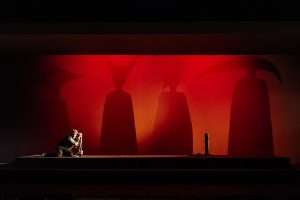
H(a)unted by Furies: Jacques Imbrailo, ENO 2026. Photo © Helen Murray.
Musically, this was a solid and involving production. At its heart was Christine Rice, swapping Helen Prejean’s nunnish mufti in her award-winning turn in Dead Man Walking for the titular Chief Priestess, her bearing the model of a princess. As her brother—the haunted, matricide-tormented, Fury-shocked Orestes—Jacques Imbrailo was the most compelling of the principals, his demeanour full of PTSD-like ticks, awkwardnesses, and visions from childish idylls; his loyal companion Pylades (Nick Pritchard) was the perfect foil. Both sang extremely well but so did all the cast and chorus, and the ENO Orchestra, conducted by David Bates (one of several debutants), were magnificent, as ever. What the opera lacks is a stand-out aria to crown the resolution of the plot, such as we get at in Fidelio or Tosca (currently on a run at ENO). That aside, this is well worth catching: but be quick!
Iphigénie en Tauride plays for three further performances at The Coliseum, on November 9, 11, and 14, 2026.