
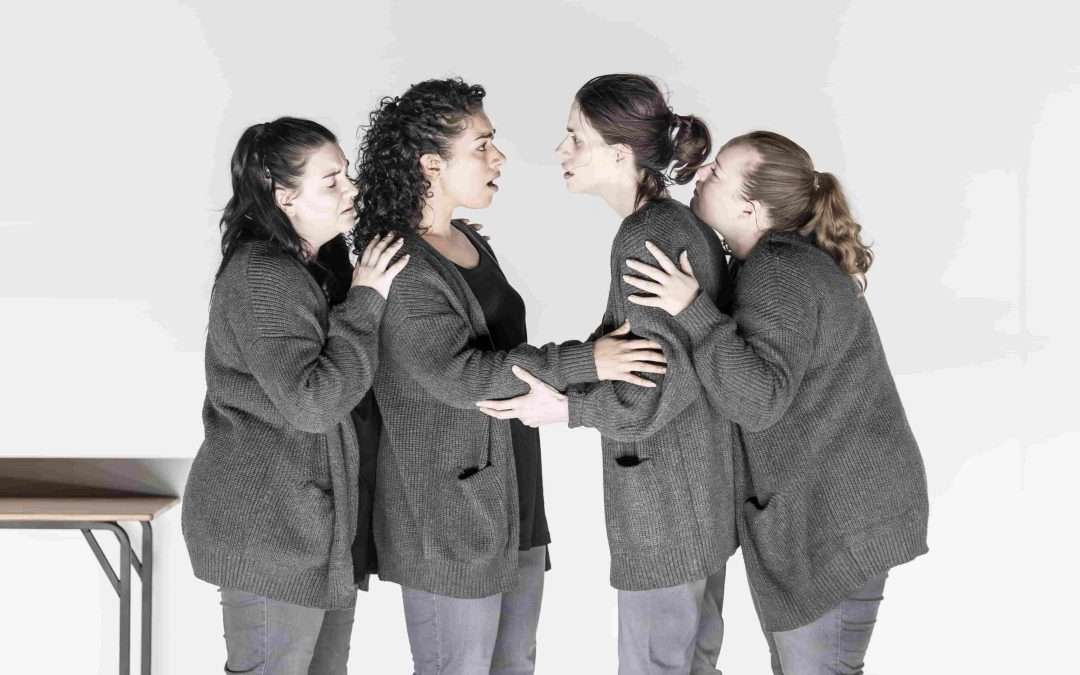
Lauren Young, Sophia Burgos, Jacquelyn Stucker and Hannah Edmunds in 4.48 Psychosis ©2026 Marc Brenner
Philip Venables: 4.48 Psychosis
Royal Opera House, Linbury Theatre/Naomi Woo
Slammed on the floor and powerless, like Zurbarán’s sacrificial lamb, and with the “Agnus Dei” from JS Bach’s B Minor Mass ghosting through the score, the central character of 4.48 Psychosis is heading for death.
We sense from the outset of Philip Venables’s opera, which takes its name from the dark early hours before dawn, that Gwen, with her nihilism and suicidal desires will not experience renewal and redemption, but will work her way out of life with determination, fury and, occasionally, humour.
The opera has become a landmark in modern music history, its genesis the searing play by Sarah Kane in which the composer and director Ted Huffman discerned operatic qualities. With instruments often voicing the characters, and with monologues that become arias, they created a memorable breakthrough work in musical theatre that won several awards. First staged at the Lyric Hammersmith in 2016 while the Royal Opera House’s Linbury Theatre was being refettled, it finally comes to the Linbury, a perfect fit for this intimate piece, a co-commission by the Royal Opera and the Guildhall School of Music and Drama.
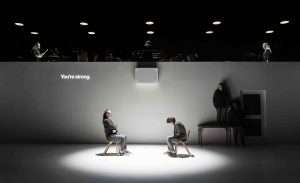
Marta Fontanals-Simmons as the doctor and Jacquelyn Stucker as Gwen ©2026 Marc Brenner
Love and death – in short, life – are its themes. Gwen is sick with unrequited romantic passion, and the love of friends is not enough to sustain her. Her mental health is batted around by professionals, patient and doctor most brilliantly impersonated by Chroma percussionists Catherine Ring and Delia Stevens. They trade wordless blows across the chamber orchestra, raised high above the action which plays out in a bleak white room below (designer Hannah Clark). Doors open and close, furniture comes and goes, but the visual interest lies entirely in the vigorous cast of six, all women, identically dressed, playing friends, nurses, tormentors.
American soprano Jacquelyn Stucker as Gwen is outstanding vocally and physically, navigating the choppy rise and fall of reason and despair. Face to face with her doctor (dependable mezzo-soprano Marta Fontanals-Simmons), their tetchy sessions are entirely drummed out, with the occasional, comical, ping of a question mark. Their confrontations occasionally plateau into peaceful agreement; they like each other. But the doctor can take refuge in the happy home life that Gwen will never know.
Venables’s rich score, quotations from Bach apart, careens through musical styles, from the anodyne background noodling in the treatment room or a single, breath-like flute to swelling tuttis. The 12 freelance musicians of the collective Chroma play with character and passion, Naomi Woo conducting with energy and precision.
Ten years since it exploded into the repertoire – there have been many stagings elsewhere since – 4.48 Psychosis occasionally feels a little dated. Perhaps there are so many more things to distress a vulnerable personality today. Social media was not the cruel scourge it can be today, and fewer power-bullies strode the international stage. But timeless is the inadequacy, arguably even greater than when the play was written, of mental health services. A bit of talking therapy and lots and lots of drugs are on offer. The latter keep Gwen alive, then help to kill her.
The opera is impossible to experience without remembering that Sarah Kane took her own life at the age of 28 in 1999, and that the play that inspired this opera was first staged posthumously. It was her brother Simon who agreed to the opera. If Gwen is sometimes Sarah, she is also countless other patients. This operatic scream cries out for compassion and wrestles with the unfathomable unhappiness that can befall humankind in the lottery of life.
4.48 Psychosis is sung in English with English surtitles. Further performances are on October 22, 24 and 25