
Puccini: Tosca
ENO / Ben Glassberg
The Coliseum, London, November 7, 2026
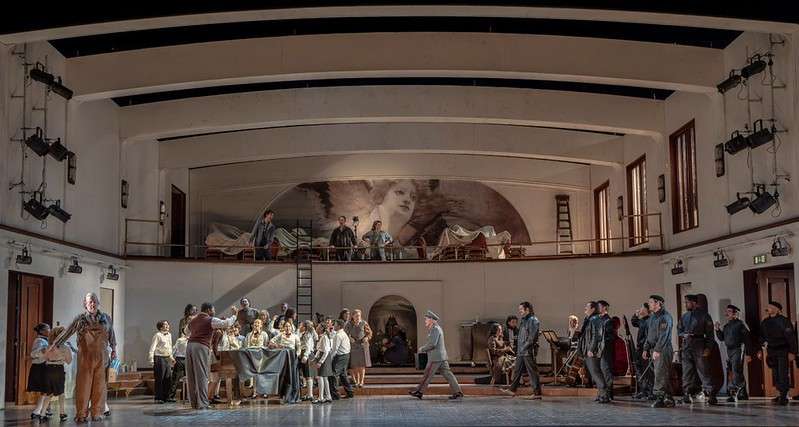
I realised with a start that it had been four years since I last saw Tosca on stage. That was at ENO, too, a comparatively straightforward but well-thought-through production inherited from a pre-Covid Finnish National Opera staging. For the 2026-7 season, Annilese Miskimmon has “reimagined” the opera, amending its very specific locations (church, place of justice, execution yard) to a single set (designed in muted colours by Rosanne Vize) representing a concert hall—complete with shrine to the Virgin, incongruously, and a fresco of a divine-looking woman’s visage—within the wider context of a more modern “unnamed European state”. This does prepare a link to ENO’s “sister production” of Saariaho’s Adriana Mater later in November—the two operas will even be performed in succession on 5th December—and may make further sense for this updated Tosca for the 2020s; we shall see.
I have to confess that the concert hall looked more like a nondescript modern church, the “unnamed European state” a South American banana republic rather. True, the constant stream of actors bearing musical instruments (including a curiously mute string quartet) added to the declared ambience but with little dramatic relevance. The escalating violence done to the instruments in particular did have a certain shock value but this, together with the pile of discarded items as surrogate for a Nazi book-burning, seemed a bit clumsy. The Netflix-style violence meted out to the usually mute incidental character of Attavanti and one or two chorus members was another aspect in a rather busy production full of distractions that, ultimately, added little to the core story: of a repressive regime, with an escaped dissident on the run (Attavanti is his sister), shielded by an artist (Cavaradossi) whose lover, the titular diva, is the object of bestial desire on the part of one of opera’s vilest villains.
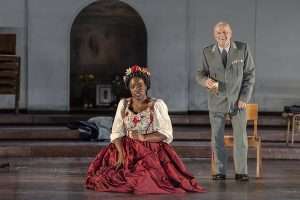
Tosca and Scarpia bargain in The Coliseum, ENO 2026 © Ellie Kurttz
The titular diva was passionately sung by Axelle Fanyo, her American, at times almost Gospel, twang providing a rather more pertinent contemporary sonic reimagining. She dominated her scenes with tremendous presence unlike Chaz’men Williams-Ali who seemed ill at ease as Cavaradossi, both dramatically and in being unable to make himself heard whenever he moved upstage. By contrast, upstaging everyone was Christopher Purves as Scarpia, cold and calculating with no redeeming features. (Miskimmon is quoted in the booklet as saying that there is “no character in opera closer to Mussolini than Scarpia”: I disagree; Scarpia is a small-town villain and his villainy, even when exercised with such police-state aggression, is small and petty.) There was nothing small-scale about Purves’ depiction of the villain, however, one of the most convincing I have seen.
Other cast members supported admirably but the main musical weight was borne by Fanyo, and the ENO Orchestra, powerful and sumptuous as always, galvanised and controlled by Ben Glassberg with great aplomb. And there’s the rub, despite all the distractions—what is Osian Wyn Bowen’s Spoleta wearing around his neck in Act 1?, the endless march of children from Marlborough Primary School and actors bearing musical instruments, even the surprise ending (no spoilers, sorry)—music is at the heart of this production with a compelling Tosca buried just below the surface. Adriana Mater may yet amend perceptions, however.
Tosca plays for ten further performances at The Coliseum, to December 11, 2026.