

Kenneth Kellogg, Rosie Aldridge, Mark Le Brocq, ENO’s Rise and Fall of the City of Mahagonny © Tristram Kenton 2026
Weill: The Rise and Fall of the City of Mahagonny
ENO / André de Ridder
The Coliseum, London, February 16, 2026
There is a heartlessness, a calculated emotional soullessness in Mahagonny, not just the fictional hedonistic resort of Brecht and Weill’s celebratedly scandalous creation, but at the opera’s very core. It does not help that there is not a single character that one really cares about or feels sympathetic to, whether the hapless, emotionally stunted Jack O’Brien (nicely acted and sung by former Harewood Artist, Elgan Llŷr Thomas) who gorges himself to death, or Alaska Wolf Joe (sepulchrally sung by bass David Shipley) who gets himself killed in an unwise boxing match, and especially not the nearest thing the opera has to a central hero, Jimmy McIntyre, who buys everyone in the town a drink and is executed since he cannot pay his bar bill; Simon O’Neill caught his contradictory complex of emotions and motivations with just the right juxtaposition of rage and detachment. Very Brecht.
These were the victims, then, those that stayed in the cess-pit of excess that most visitors quickly tired of, leaving without leaving their cash. That Mahagonny the place was so corrupt was no accident, founded straight after the somewhat Hindemithian overture by three crooks on the run whose truck breaks down in the desert. Unable to go forward to the gold-rush coast (too much work) or go back (the Police have their pictures), they decide to stay put and make their fortune fleecing anyone who ventures into their “spider’s web”. The three crooks are the only ones who prosper, by hook and usually crook: Rosie Aldridge was formidable as the brains of the operation, Widow Begbick, ably supported by Mark Le Brocq (Fatty the Bookkeeper) and Kenneth Kellogg as the muscles, Trinity Moses. Mahagonny itself leads a charmed life despite of everything, including a tap-dancing hurricane (Adam Taylor) – the only really comedic section of the evening – which had previously wiped out the law enforcement posse on the founders’ trail.
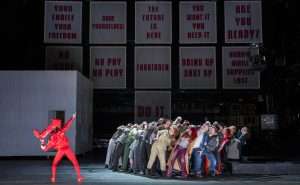
A tap-dancing Typhoon in ENO’s Mahagonny ©Tristram Kenton 2026
What of the others, though, the grifters and workers who somehow keep the city on its seamy, steamy course? Foremost of these, of course, is Jenny Smith whose iconic Alabama Song, the opera’s most famous number accompanies her first entrance with her “girls”. Danielle de Niese – who last appeared at ENO as the Guardian Angel in Jake Heggie’s It’s a Wonderful Life – added glamour, glitz and some nifty microphone and megaphone usage as Jenny, Jimmy McIntyre’s love interest, but not quite enough sleaze. Her ultimate abandonment of Jimmy was, however, very convincingly achieved, as Jimmy’s last remaining friend, Bank-Account Billy (a nicely nuanced turn from another former Harewood Artist, Alex Otterburn), feeds her dollar bills.
And there’s the nub: in a desert bereft of morals, all that remains is human avarice. Jamie Manton’s production underlined the ramshackle, jerry-built quality of Mahagonny as well as its inhabitants. Milla Clarke’s set and costumes were a triumph of the ordinary: this was a production that could almost have been staged in the street or car park. Indeed, the Coliseum was perhaps a touch too large: occasionally, solo voices got lost in the acoustic and not because the orchestral accompaniment overwhelmed them. ENO’s Music Director Designate André de Ridder balanced things very adroitly from the pit. Of course, the ENO Orchestra can play anything superbly as they proved once again and the chorus did not put a foot wrong, even in the unsubtle, agit-prop finale. Again, very Brecht. I enjoyed, however, the occasional resonances throughout of Busoni (Weill’s former teacher) amidst the tapestry of jazz, ragtime, cabaret, and counterpoint.
Writing in the programme book, de Ridder stated how his “favourite opera singers are proper singing actors” whose “knowledge of how to speak through singing” or “within the singing … is absolutely essential” in Weill – and so it proved. If this production is anything to go by, his tenure, to start in 2027, promises much.
Mahagonny is sung in English with English surtitles. A final performance is on February 20, 2026