
During the final ballot, Lawrence’s searching glance finds the Sistine’s shattered windows, through which external sounds are audible – most prominently, birdsong. Several previous scenes had taken place in a drab office featuring caged, chirping birds, suggesting that the Holy Spirit (traditionally depicted in Christian art as a dove) has now become liberated, allowing the divine intercession to belatedly occur.
— from my Sight & Sound review of Conclave (2024)
Edward Berger’s film has rightly been praised for its accuracy in depicting the mechanics of the papal election plus the dramas and controversies which invariably swirl around it. But based on my experiences in St Peter’s Square on Wednesday 7th and Thursday 8th May 2025, I believe Conclave‘s birdsong is an imaginative touch of poetic license.
Those of us gathered there on what turned out to be the decisive Thursday — patiently awaiting the famed white smoke from the Sistine Chapel’s temporary chimney, and a little later the first glimpse of the new pontiff — had plenty of time to contemplate the piazza’s avian fauna (and also to contemplate how comically unimpressive the Sistine Chapel looks from St Peter’s Square).
And none of those birds make sounds anything like the ones heard by Cardinal Lawrence: a few fountain-frolicking ducks, plentiful pigeons and sparrows and, more raucously conspicuous, seagulls — who from time to time zealously and amusingly defended their aerial turf against an encroaching camera-drone.
The noisy, noisome scavenger Larus argentatus was first recorded in the early 1970s. Even by the mid-90s there were only 50 or so nests. Now they are ubiquitous, inescapable — so it’s apt that two parents and a fluffy chick were right next to the chimney when the white smoke appeared just after 6pm.
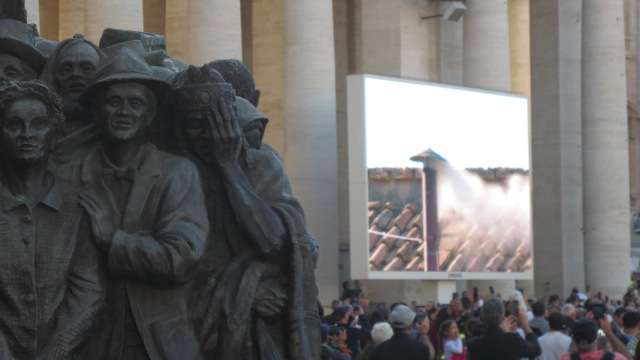
Close-up video-images of chimney, smoke and seagulls flashed around the world; we in the Square had a close-up view of the same perspective via half a dozen Samsung large video-display. As the fumata bianca billowed forth its surprisingly copious and protracted flow, excited cheering and clapping swept the throng of 50,000. And as all the church bells in the capital pealed out, across the city people began — following long-established Roman tradition — scurrying towards the Vatican, most of them on foot.
The duration of the 2025 conclave was typical of the most recent few: two days, four ballots, and three sets of smoke. The pope is never elected on the first day. I’d visited the Square for an hour or so late on Wednesday afternoon solely to get a general lay of the land — and perhaps see the first emission of (black) smoke, expected between 5pm and 6pm. This was when I met the Australian journalist Rob Harris and inadvertently retraced Ralph Fiennes’ steps through the Vatican tunnel (as detailed in part one of this article).
The big surprise on the Wednesday was that the black smoke didn’t appear until after 9pm (by all accounts because of a longer-than-expected pre-vote pep-talk by nonagenarian star-preacher Cardinal Raniero Cantalamessa). By this point I was in Sandhu Caffè, a humble tavola calda spot very near Termini station, sipping the day’s fifth or sixth caffè al ginseng ahead of taking the train to Aprilia, where I was staying. The TV showing the black smoke grabbed the attention of all staff and patrons present (much later I learned that for the duration of the conclave Italian telly permanently includes an live-relay inset of the chimney, just in case the cardinals surprise everybody with a nocturnal vote.)
I arrived in Aprilia around 10pm, decidedly ravenous, and after a bit of wandering happily stumbled across Er Panino Matta, a late-serving fast-food joint popular wth local youth. Feeling very “Anthony Bourdain,” I had a top-drawer salsiccia sandwich then headed back to the hotel to update my papabile rankings.
Reports from Rome relating to Honduras’s Cardinal Rodriguez Maradiaga — one of the 17 names in my original 2003 ‘Popewatch’ — indicated that the expected “Francis continuation” might be in jeopardy. This was a negative for several prominent contenders, including that stealthily rising “dark horse” from the USA, Robert Prevost. Wary of making too many changes in the final furlong, I dropped him just a single notch, from #3 to #4.
I slept soundly, woke early the next (sunny) day and made the Rome-bound 8.42 train. I wasn’t planning to be in the Square for the first smoke of the day (expected between 11am and noon), instead wandered through the city and lunched with a locally-based friend. My last stop before St Peter’s was in Bar Latteria Giuliani around the corner on Borgo Pio, where I met a American journalist whom I hadn’t seen since before the COVID pandemic. A widely-travelled reporter, before moving to Italy he’d been based in Peru for five years…
I made it to the Piazza around 2.30pm and took up a position I’d doped out as a suitable spot the day before — in the shady, high-ceilinged colonnade just behind the circular, UFO-like post-office. It’s estimated that at this stage there were at least 20,000 people in the Piazza already; but it’s a huge space, and felt far from crowded.
I’d stay in the same area for the best part of five hours (if there were toilet facilities available I never saw one), mainly passing the time by reading Jonathan Franzen’s latest novel Crossroads (2021). One of the main characters — the last chapters focus squarely on him — is a Chicago teenager, Clem, born in the 1950s into a devout family — religious faith is a major element in the novel. After dropping out of college he heads south and ends up in Peru. The novel specifically mentions him working in several Peruvian cities including the country’s fourth-largest, Chiclayo (pop. 609,400).
I took a break from reading just before 6pm and stretched for a while, watching that seagull family on the Samsung screens while I exercised. And then at 6.07, when my eyes happened to be on the chimney, there it was: the white smoke. Roars went up in every corner of the square, and I hurried forward a few yards to get a closer view of the balcony where the pope would emerge after the traditional delay of an hour.
I noticed that my hands were shaking as I typed out SMS messages ((I normally have decidedly non-shaky hands), replying to the many texts from friends who knew I was in the Square. I was soon hemmed in — more cosily than uncomfortably — on all sides. A hubbub of different languages all around; flags of myriad nations waved overhead in all corners of the Square, including a large American one a few metres in front of where I stood )the flag a bit too large for those standing behind it and whose view of the balcony was impinged; after several multilingual catcalls, it was grudgingly lowered.).
For the next sixty or so minutes suspense steadily mounted as the Square filled up, the crowds also taking up positions in the Via de Conciliazone which connects the Vatican with central Rome. Various manifestations of well-drilled ceremonial occupied our attention, including the marching phalanxes of the elaborately-uniformed Swiss Guard. The Catholic Church, which has been running conclaves for literally centuries, does know how to put on an impressive show.
There were around 150,000 present by the time the tall windows behind the balcony opened, and camerlengo Cardinal Dominique Mamberti stepped out (sparking wild scenes among the crowd) to deliver a scad of Latin including the fabled words “Habemus papam” (at which the crowd became even more joyously agitated.)
By this point I was utterly convinced that we were about to hear the words “Petrum Baptisteum” — the official always reads out the given names of the “lucky” cardinal, before the surname — indicating Pierbattista Pizzaballa, the Patriarch of Jerusalem, #1 on my final prediction list. Looking back at my updates, I think it’s not a coincidence that Pizzaballa took over as #1 on October 7th 2024, exactly one week after I saw Conclave at San Sebastian Film Festival. The pope elected in the film is one who has arrived in Rome fresh from his conflict-ravaged diocese in the Middle East; the main difference is that the picture’s Cardinal Benitez entered his conclave as an unconsidered super-longshot. Pizzaballa, by contrast, had been a name on many lips and lists for weeks.
But when Mamberti finally spoke, his supporters soon realised their (our?) fate: “Eminentissimum ac Reverendissimum Dominum, Dominum Robertum Franciscum. Sanctae Romanae Ecclesiae Cardinalem Prevost.” As realisation of Prevost’s nationality swept the Square, the American flag a few yards in front of me was hoist back aloft and energetically waved in triumph. I was in a state of mild shock, realising that ‘Papal Predictor’ had been totally spot-on with his absurd-seeming prophecy on 1st March. This was arguably the greatest feat of prediction, in any medium, in history — enough to make Nostradamus look like a novice.
And while the bookies had been dismissive of Prevost’s chances with quotes of 40/1 and 50/1, he’d been high in my lists for the last few days. Not that I was able to get a bet on myself, such things being impossible in Austria where I live (ditto in Rome and the Vatican, where gambling on the conclave is reportedly an excommunicable offence.) But I wasn’t really bothered about this; the fact that I was there to witness these events was enough of a “win.”
The (1950s-born) Chicagoan made history as first ever American pope, and the first native English-speaker since the death of Adrian IV — Herefordshire’s Nicholas Breakspear — in 1159. But his first public pronouncement as pontiff was in fluent Italian, apart from a digression in Spanish when he greeted his friends back in the South American country where for eight years he had been bishop of a certain city with a population of 609.400: “Si me permiten también, una palabra, un saludo. De modo particular a mi querida diócesis de Chiclayo en Perú…”
“If you allow me, a word, a greeting. In particular, to my beloved diocese of Chiclayo in Peru…”
Total cosmic coincidence, of course, that of all the books I happened to be reading in St Peter’s Square when the pope was elected, it should be Franzen’s Crossroads. And that the last person I should meet before entering the piazza on that day should be an American previously based in Peru. But part of me, a not-so-rational part, reckons that I was perhaps in the Twilight Zone-ish territory of omen.
Or specifically Richard Donner’s satanic smash The Omen (1976), which was probably the first film with significant sequences set and shot in Rome that I can remember. I saw it on TV in 1981, aged 10; the following year the US-set sequel Damien: Omen II (1979), and a year or two later the UK-set The Final Conflict: Omen III (1982). Each would feature prominently in the all-time top 10s I regularly updated at the time. The Omen was for a couple of years my favourite film.
The first picture and its sequels were a major influence during my pre-teen years (before I had access to video, I bought the novelisations) and I identified with the central character to the extent that I started to seriously ponder whether I might even be the Antichrist myself. The appeal of this “franchise” — revived via last year’s largely Rome-based prequel The First Omen (like, the original film, released in the middle of a contentious US election-year) — waned quite quickly during adolescence. I moved on to more artistically respectable enterprises, spearheaded by Nicolas Roeg’s Don’t Look Now (1983) — largely set in Italy, and dealing at its heart with a messy collision between reason and belief in the supernatural.
But if I’d been maintaining an “Antichrist-Watch” as well as a “Popewatch” in 2003 and after, readers would have eventually spotted a famous name eerily mirroring The Omen series’ diabolical protagonist: D – – – – – T – – – -. A man whose father had the middle name “Christ.”
Fans of the 1976 Omen will recall the prophetic (doggerel) poem foretelling Damien Thorn’s emergence: “From the eternal sea he rises…,” understood in the picture’s mythology to mean the world of politics. In The Final Conflict Damien duly becomes the US Ambassador to the UK; the poster features a then-unknown Sam Neill smiling diabolically in front of the Presidential seal.
Spool forward 44 years and we have a White House incumbent who chose to “satirically” mark/mock the 2025 conclave via a deliberately offensive AI image showing himself in papal crown and white attire. While I don’t accept Christ’s divinity, I can fully share Paul Verhoeven’s respect for the radical revolutionary as described in the gospels. I also sympathise with Luis Buñuel’s famous quip, “thank God I’m an atheist,” which means I can’t really go so far as to posit that the President of the United States is actually The Antichrist. But I wouldn’t hesitate to say that his behaviour has long been consistently, emphatically and often grotesquely “anti” all of Christ’s teachings.
In retrospect and leaving aside eschatological speculations — the decision by the cardinals (who will of course to a man firmly believe in the reality of the Antichrist) to elect an American pope at this specific juncture feels like a tactical masterstroke. All of a sudden, you-know-who is no longer the American with the biggest following. How this must gall him. In St Peter’s Square, after Prevost’s opening speech, an adjacent Frenchman asked me my opinion: “C’est le cauchemar le plus pire de Trump,” I happily replied.
While not quite the most absolutely progressive of feasible candidates, Prevost pre-election had been unequivocal in his stances as expressed on social media. The final tweet he personally wrote began “JD Vance is wrong,” a firm rebuttal of American politics’ most prominent Catholic convert.
His @DrPrevost account’s last activity retweeted sharp criticism by Catholic commentator Rocco Palmo of the US government’s brutal El Salvador deportation shenanigans. His choice of papal name, Leo, is an unequivocal tribute to Pope Leo XIII, who reigned from 1878 to 1903 and is best remembered for siding with the world’s working poor in a period of industrialisation and exploitation.
Of course it remains to be seen whether the papacy of Prevost — by all accounts a steady-as-she-goes sort of midwesterner — will have the impact of Leo XIII or of John Paul II, whose 1978 election at least semi-indirectly speeded the collapse of Communism across eastern Europe including the USSR.
But we who revile Trump, all his works (and those who opportunistically stand with him in this continent and beyond) need all the powerful friends we can muster. As Leo XIV smilingly stepped out onto the St Peter’s balcony in the warm early evening sunlight to echoing cheers of “Papa Leone,” it somehow felt like the sound of a tide turning. At a pivotal early moment in Conclave, Cardinal Lawrence persuasively preaches the value of doubt: “Without doubt, there is no need for faith.” But, right now, I want to believe.