
Broadway World’s Gary Naylor travels to Romania for this year’s IATC World Congress and shares his diary of the experience.
May 20, 3am, Luton Airport
I sit in Pret a Manger, reflecting, as I always do in terminals, on JG Ballard’s observation that airports form a single, discontinuous city, having far more in common with each other than with the regions and cities they serve.
That apercu is even more relevant in the 2020s, when one sees the same franchises selling the same food in the same way, the entire experience controlled by branding’s iron fist.
Still, one doesn’t go to London’s Luton Airport for its aesthetic delights. I’m on my way to annual World Congress of The International Association of Theatre Critics (IATC) 2026, which takes place in Craiova in Romania this year.
May 20, 5pm, Craiova
Craiova’s National Theatre has the look and feel of Chisinau’s State Opera House – a big airy space, lots of hard marble surfaces and soulless. Spray paint it with a cheap gold veneer and it would find favour with an American president you’ve heard of.
Industrious women, many of whom are student volunteers, buzz around and instantly locate my ID, the all-important passport of a conference.
The conference organiser, Andrada Coiciu, apologises for all her emails – I assure her that every one was needed – and prints local maps for me, as my 4G is, in perfect timing, not working.
Meanwhile, techies are setting up for the concurrent International Shakespeare Festival. A bust of The Man looks on, possibly thinking of The Mechanicals, while a variety of illustrated caricatures are ranged behind him, propped on easels.

Photo by Gary Naylor.
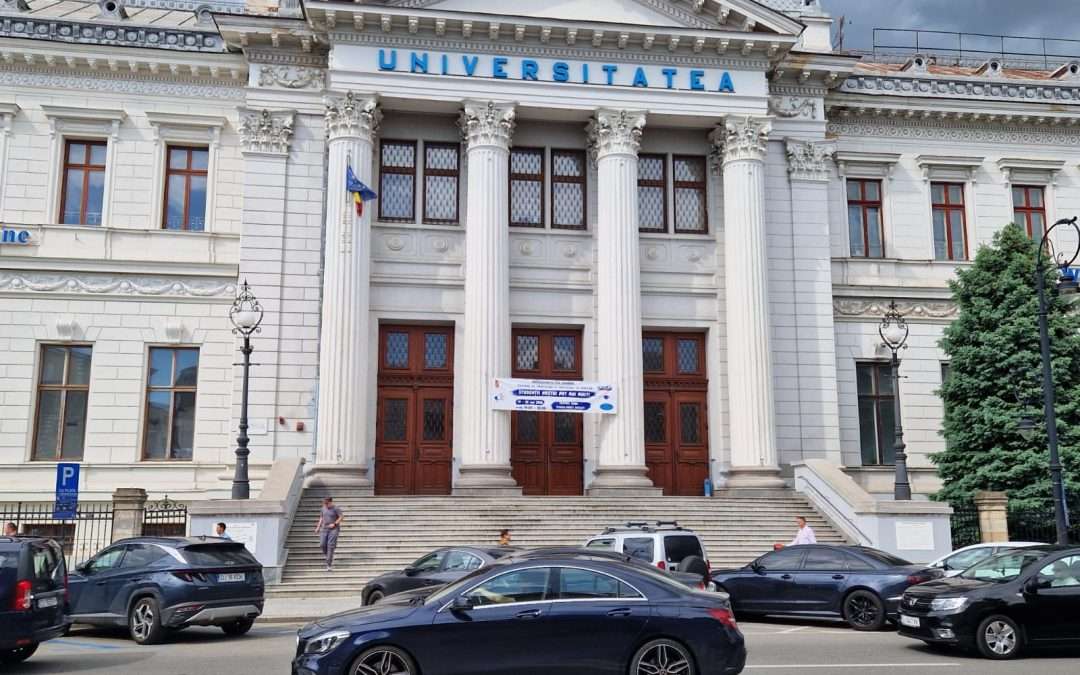
Outside, large posters announce the event, competing with the Greek columns of the university next door. I buy provisions and, as an unexpected and unwelcome thunderstorm closes in from nowhere, I hurry back to my hotel.
I half watch Aston Villa cruise to winning the Europa League on the fuzzy TV and fall asleep, apprehensive about jetlag tomorrow.
May 21, 2pm, University of Craiova
If airports are more like each other than their immediate environs, so too are international conferences. Matters were strongly weighted towards the academic. My bingo card was correct but in the wrong order. I’d have gone Derrida, Adorno and Benjamin in the mentions, but it was Adorno, Benjamin and Derrida – all in the first 20 mins. Two decades ago, I was fluent in that academic language, but there’s a reason I left it behind with few regrets.
Learned presentations on how Shakespeare is interpreted in different countries are read out to an audience who nod but have to be all but frog-marched into a question or two. Many speakers are operating in a second or even third language, so one can’t be too critical – but, not for the first time, I’m surprised by the lack of theatricality demonstrated by theatre people.
In the university antechamber, an exhibition of historical posters of Shakespearean productions from the University of Birmingham is another reminder of just how much imagination and work has gone into this city-wide event. I marvel at its scale – I can’t get three people to meet at a bus stop at an agreed time, so the effort and organisation here is laudable.
At the lunch break, our hall is the venue for a graduation ceremony, so, as we file out for food, caped, capped and self-conscious graduates file in. So that’s airports, conferences and university convocations.
May 21, 11pm, Rexton Hotel
It’s fair to say, but not fair to today’s batch of individual speakers, that on the last lap in a field of 12 runners and riders, one’s attention saps. Surely some could do better than to just read out a paper verbatim?
In the evening, Japanese company Kakushinhan give a radical interpretation of Titus Andronicus, which only serves to underline what an adolescent play it is. They start 30 minutes late and run 28 minutes over the billed two hours. With no interval. One star behaviour, I’d suggest.
As ever, a little of the avant garde goes a long way. A minute more and I’d have joined in the closing carnage just to get out.
May 22, 11pm Rexton Hotel
After a morning dedicated to the tedious, if necessary, business of IATC motions and elections, matters in the hall perk up.
Before that relief, I speculated, with mixed feelings, on how close we are to our Roman antecedents, the lanyard elite, gathered like senators in the Forum, voting on our representatives. There was no technology in play and no sophisticated voting systems to reflect our choices. To spend pretty much a whole morning on such business felt inefficient – like the upcoming World Cup’s 72 matches played to reduce 48 teams to 32.
After more WhatsApp number swapping in the lunch break – conference organisers should just ask permission to release this information, I feel, as it’s the primary mode of communication these days – Professor Maria Shevtsova steps up to become the tenth recipient of the International Association of Theatre Critics’ Thalia Prize.
With many connections to the UK, including the University of Lancaster and Goldsmiths, her speech is, pleasantly, much less academic than many the previous day. She stalks without notes and references many productions she has seen recently in London and Paris, with shoutouts to Robert Icke, Ivo van Hove and Sadie Sink along the way.
She also makes an impassioned defence of theatre and its criticism in the face of creeping authoritarianism, the threat of AI and relentless cost-cutting. It is just about the first mention of AI across the two days, which surprises me, even if Shakey himself favoured the quill over Chat GPT. She says that she has repeatedly refused to allow her books, published by Cambridge University Press, to be scraped by LLMs. Bravo!
A longish walk in the evening brings me to a Soviet-era building, a military school or cultural centre, with heavy wood, high ceilings and shiny marble steps whose edges are hard to see. But the staff are wonderfully warm and it’s a well-appointed theatre.
Verdi’s Otello is presented by The Romanian Opera Craiova, curiously costumed as if for the Ascot scene in My Fair Lady, and beautifully played and sung it is. I guess I have to give a pass to the casting of a white lead, as ethnic diversity is not very apparent in this city and, at least, he isn’t in blackface.
That being said, it jars almost as much that he is somewhat shorter than his Desdemona, dazzlingly sung and acted by Renata Vari, who could pass for Jodie Comer. I half-expect her to smother him, come the terrifying denouement.
May 23, 5pm, Rexton Hotel
Another tussle with the 4G to access the increasingly essential tool of the traveller, Google Maps, and it’s off for a morning walk, to Shakespeare’s Village, in a huge municipal park.
Some stalls are not yet open, but a travelling company from England is on the open-air stage and getting started with the star-crossed lovers bit.
I decide to forgo the damp hay bale seats and swung by the Young Writers workshop at the university to see some very bright-eyed aspirant journalists and academics say a few words. I explain that ‘critic’ in the UK refers primarily to the reviewer, who must write swiftly and engagingly for a general audience. The more European idea of the critic as an academic writing monographs with footnotes for an academic audience exists, but more as a sideline to the main gig.
I manage to get a laugh or two, when humour is, as ever, in short supply in multilingual and transnational events.
Afterwards, I head back to the hotel, knowing the feeling that the international conference plunge is about to hit. I spend my afternoon watching the Giro d’Italia on TV with Romanian commentary and recharging my literal and metaphorical batteries.
May 24, 11pm, Rexton Hotel
I’m back to the Craiova National Theatre in the afternoon for another infuriatingly late start and a spot on the back row of its temporary seating, with only a narrow metal railing between me and a 25-foot drop backwards. It strikes me that, even at a large venue like this, there is no bar and very little seating despite plenty of room.
Another long haul with no interval, this time for Compagnia de Colombari’s take on King Lear. Although set in an indeterminate period, the speeches by the sisters (well, Goneril and Regan) make it sound very 2026. The placing of the surtitle screen high above the stage makes it impossible to see both it and the actors without tilting one’s head back and forth, as if at a vertical tennis match. For many Shakespeare plays, I would hardly need to look, but for Lear, I definitely do.
The last play I take in as my four days here draw to a close is much the best. Teatrul Fără Nume (The Theater Without a Name) certainly put its stamp on a show billed as After A Midsummer Night’s Dream. Set in a dictatorship, Hippolyta was a chained Amazon Queen, Theseus’s prize for his military conquest, and Nick Bottom, though still an enthusiastic weaver-actor (the joke works better in Romanian), is a handsome man, transformed by his experience as a donkey into a contemplative heartthrob who, touchingly, wins the love of Titania. As usual, I was left thinking that Demetrius gets considerably more than he deserves, come the curtain.
If we lose the poetry in the English translation of the Romanian translation (the surtitles always within our eyeline) we gain much, with greater clarity in the storytelling and interesting takes on familiar characters. I could see this production going to Edinburgh or having a run at The Arcola or Riverside Studios in London. It brims with humour, warmth and poignancy without ever losing its edge.
The nerve-wracking ordeal of online check-in completed, it’ll be a hot three hours on the coach to Bucharest Airport and onwards to an equally hot London. And Stratford Upon Avon itself, no less, tomorrow night.
The acid test of any event is whether you would go again – and I would, both to the conference and the festival. That said, I’d very much like to see a tilt in the discourse from the ‘scholarly’ to the ‘scholarly-informed’, placing the practice of theatre-making and our reaction to it at the centre of the debate. How do young people see Shakespeare? How is his work used in education? Perhaps most importantly of all, how will the rapidly changing media landscape and its embrace of AI affect those who think and write about theatre in the years to come?
Oh, and a carbon reduction strategy for the IATC seems long overdue.
You can find more information on the IATC and its work here.
Gary Naylor is chief London reviewer for BroadwayWorld and feels privileged to see so much of his home city’s theatre.