
Cruelty and danger are only just below the surface in the games children play at the opening of Jack Furness’s new production for Garsington Opera of Tchaikovsky’s The Queen of Spades. To be more precise, the boys’ games: while girls are playing hopscotch, the boys duff up one of their number.
Those hopscotchers may break male hearts, however, when they leave the playground behind. Lisa, in the libretto by the composer’s brother, Modeste, based on Pushkin’s novella, dumps her handsome, kindly prince in favour of a reckless, brooding stranger. It’s not a good swop on paper, or in Jack Furness’s eye-catching production.
The cheerful opening scene, with games for the young and gossip for their elders, resembles a summery prospect by Boudin, in Tom Piper’s painterly set and costume design, rooted in the interiors and fashions of grand imperial Russian and European society. Characters saunter on-stage through Garsington’s enviable gardens. Lizzie Powell’s expressive lighting, Lucy Burge’s exciting choreography and Furness’s eye for a tableau paint a pretty scene.

Lucy Burge’s choreography for Garsington Opera’s The Queen of Spades Photo: Julian Guidera
Life is at least superficially, pleasant for some. But with the arrival of Herman, tabs blot out the sun, and the audience is plunged into the darkness that emanates from him
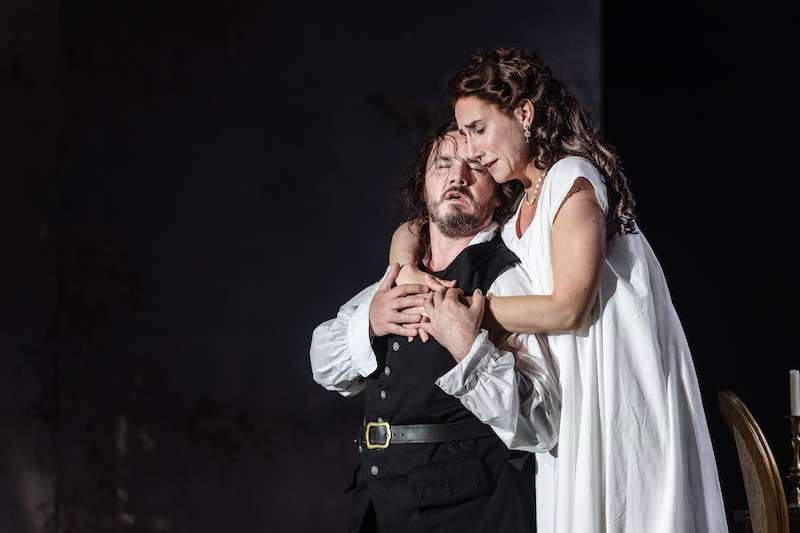
It takes some doing to drop baritone Roderick Williams’ polished and gracious Prince Yeletsky in favour of an uncertain future with Aaron Cawley’s Herman. The Irish-born tenor, who has already sung this role in Brno, Toulon, Avignon and Bari, and who has been a company principal at Wiesbaden for 11 years, is no stranger to Herman or to high expectations. His is a wild performance, occasionally inventive in intonation, the voice big and raw.
Maybe it is fatigue with Yelentsky’s unfailing charm combined with the exacting nature of life with her countess aunt, the faded Venus of Moscow, that propels US soprano Laura Wilde’s otherwise somewhat homely Lisa into oblivion with hapless Herman. Her matter-of-fact performance is arguably no match for the glamour and spectacle of the production as a whole.

Diana Montague’s Countess. Photo: Clive Barda/ArenaPAL
In the pit, Garsington artistic director Douglas Boyd has a ball with the Philharmonia Orchestra, and here the music has the acuteness, passion and drive sometimes lacking in the relationship on stage. Particularly affecting bassoon and cello work voice Tchaikovsky’s gift for plumbing the depths of despair.
The game that doomed Herman favours is Faro, a grown-up Snap!, which swept through the western world in the 18th and 19th centuries. The Countess was an addict, exchanging her virtue for the secret of three winning cards, a secret that Herman will stop at nothing to learn. A nocturnal visit to love-struck Lisa brings him face to face and alone with Diana Montague’s weary, imperious Countess. Chance is his watchword: he takes his, with lasting consequences.
Slight disappointment with the central couple is more that outweighed by some striking performances in other roles. In a Garsington debut, the luscious bass-baritone of South-African-born, Royal College of Music laureate and former Royal Ballet and Opera Jette Parker artist Simon Shibambu underpins a characterful performance. Also a Jette Parker alumna, mezzo-soprano Stephanie Wake-Edwards returns to Garsington as Lisa’s confidante Polina.
With its Mozartian pastiche, the revealing pastoral masque shows Wilde at her best, acting Chloe to Wake-Edwards’s puppety Daphnis. Bass-baritone Robert Hayward, who as Count Tomsky gives a masterclass in exposition, is their Plutus.
With thematic, melodic and orchestral similarities to the composer’s more frequently performed Eugene Onegin, this arresting production will, with luck, return, just as the Bruno Ravella’s exquisite and award-winning Der Rosenkavalier will in 2026. Country opera houses including Garsington are ambitious in their originality, and a production as winning as this deserves to be dealt again.
Further performances are on 6, 15, 20, 26, 28 and 30 June, and 4 July. It will be broadcast by BBC Radio 3 on Saturday 11 October 2025