

As with so many of the Watts Gallery exhibitions they show us a life and meaning to the art of the 19th century that today has passed us by or seems foreign. So it is with this exhibition of Pre-Raphaelite paintings. We see John Everett Millais’ painting of The Blind Girl (1856) that depicts a girl together with her younger sister, sheltering together from a passing rain storm under the older child’s shawl. The younger sister gazes at a double rainbow; the older one seems to be in contemplation. But is she taking in the smell of the freshly damp grass? We are told that for some Victorian Christians they believed rainbows had a fragrance symbolising spiritual renewal and redemption. Thus Millais’ painting may have a meaning beyond the visual.
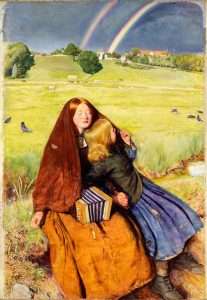
John Everett Millais, The Blind Girl, 1856, oil on canvas, 80.8 x 53.4cm. © Birmingham Museums Trust
The exhibition begins with a gloriously colourful array of Pre-Raphaelite women smelling flowers.
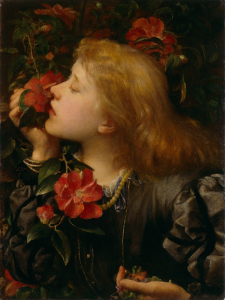
G F Watts, Ellen Terry (Choosing), 1864, oil on strawboard mounted on Gatorfoam, 47.2 x 35.2cm © National Portrait Gallery copy
Smell, however, was not always associated with redemption. Lust, forbidden fruit, sex, animality and earthly temptations were ever present associations with scents for the Victorians. More often smells that arose from decomposing matter were associated with disease. Cholera was thought to be carried in the air by smell. Edwin Chadwick, England’s first Public Health Commissioner, said in 1846 “All smell is, if it be intense, immediate acute disease.” He believed smell weakened the body making it more susceptible to disease. This was a belief that can be traced back to the Middle Ages and lingered long in the Victorian mind even after the miasma theory, that disease was transmitted by air borne smell and could be breathed in, had been disproved and displaced in the 1860s by germ theory.
Thus many of the Pre-Raphaelite beauties represented in paintings actually indicate corruption through indications of smell. The Woman in John William Waterhouse’s The Shrine (1895), shown stooping to smell some flowers, was dismissed by a contemporary critic as “by no means of a high or fine type” and “not so sensual and not so pure as she ought to be”.
Once the contemporary viewers’ attention is alerted to the Victorian beliefs in the corrupting power of smell the viewer focuses in more on the depiction of tell-tale fumes; those emanating from the vial of poison held in the hand of Evelyn de Morgan’s Medea (1889) or drug-like fumes curling from the casket that John William Waterhouse’s Psyche (1903) is opening and that sent her into a deep sleep. John Roddam Spencer Stanhope’s woman in his Thoughts of the Past (1859) is indicated as being a sex worker, the violets and primroses scattered on the floor as indicators of an innocent past childhood.

Thoughts of the Past, exhibited 1859. John Roddam Spencer Stanhope 1829-1908. Presented by Mrs F. Evans 1918.
But all is not gloom and disease in this exhibition, artists began to convey the idea of scent, not simply by depicting women smelling flowers but reimagined fragrance as vapourers clouds, as colour, rainbows or butterflies. It is a lushly colourful exhibition and a collaboration with Artphilia and Spanish fashion and fragrance house Puig adds another dimension. Puig have created bespoke fragrances to accompany two paintings, Millais’ The Blind Girl and Simeon Solomon’s A Saint of the Eastern Church (1867-8) that one can inhale in the exhibition.
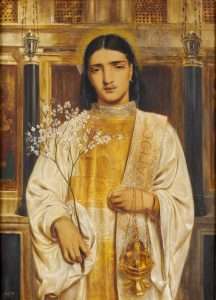
Simeon Solomon, A Saint of the Eastern Church (formerly called A Greek Acolyte), 1867 – 1868, watercolour and gum over pencil, on paper, 45.2 x 32.8cm. © Birmingham Museums Trust
There are two scents for The Blind Girl, the first aims to capture the sweet fresh aroma of the rainbow and by its association, closeness to God through smell. The second reflects more sisterly comfort as the younger child wraps herself in her sister’s rain-dampened linen and wool shawl while she regarding the rainbows in awe with its sweet smelling associations. In contrast the Puig scent that goes with the Simeon Solomon’s painting of a Saint takes the viewer into the Saint’s church replete with aromas of smouldering frankincense in its brass censer, myrtle flowers, beeswax on polished wooden pews and burning candles, cool stone columns and the saint’s different culture with its hints of then forbidden homosexuality.
This interpretation of the paintings through scent and smell is so much wider than the purely visual, it delves into the psyche.
Curated by Dr Christina Bradstreet, author of Scented Visions: Smell in Art 1850-1914 (Penn State University Press, 2022) with the support of the Watts Gallery Exhibition Curator, Corinna Henderson.
Scented Visions: Smell in Art 1850 – 1915, Watts Gallery, Compton, near Guildford, 15 May – 9 November 2025