

Picasso made prints throughout his career. His very first, made in 1899, was an etching of a Picador, El Zurdo (“The Left-handed Man”), left-handed because he did not realise printing would reverse the image. His The Frugal Meal, was the first print he made as a professional artist when he moved permanently to live in Paris in 1904 and is the print the British Museum’s exhibition opens with. He continued making prints in a very wide range of print making techniques, right up until the year before he died, when he made a series called the 156 Suite after the number in the Suite.

The frugal meal, 1904 © Succession Picasso/DACS, London 2024 This etching was the first Picasso made in Paris and is considered his first as a professional artist. It is one of his most powerful works in any medium from what is known as his Blue Period (1901-04). The period often depicted people on the margins of society, including travelling poor people and those suffering great poverty.
The British Museum holds the largest collection of his prints in this country and it is a rare treat to see the range and virtuosity of Picasso’s printmaking practice. However, as with his practice in any one of the many media he employed, to speak of his printmaking is to plunge into a practice that incorporates a web of references far beyond the printer’s press. Picasso was not to be hemmed in.
Despite the extensive literature on the artist it is rare to find explanations from Picasso himself as to what he had in mind when he made his art, so meanings or interpretations are largely by others. However, in his later years he is known to have said that “the movement of my thoughts interests me more than the thought itself”.[1] The different stages and states that the printmaking process involves seems to have allowed him to record the passage of his thoughts with “greater freedom and scope for expression – more so than with drawing”.[2] Thus one can think of his prints as stills taken from a film of Picasso’s changing thoughts. We do not, however, we do not have the whole film.
Picasso also had a vast visual memory and the subjects Picasso depicted in his prints, as in his other media, represent a stream of consciousness of whatever were his current concerns. Among them we see friends and lovers not depicted as portraits perse but as archetypes and mythic characters. Beyond his own personal visual memory are other source materials and the exhibition includes items, both two-and three-dimensional that added to his visual memory. A bronze Etrusco-Latin mirror from 325 – 300BCE from the British Museum’s collections is exactly the sort of piece Picasso would have seen in the Louvre, where he is known to have spent many hours looking, studying, enquiring into how the Ancients depicted things, how they used lines, indicated volumes, distance, light, shade, space in ways that differed from his own classically academic training. Having looked at these source materials, interrogated them, he set about dismantling the conventions of academic art he had been so thoroughly trained in by his father and then in the best art academies in Spain. This how he arrived at Cubism.
The clear, elegant lines of the Etrusco-Latin mirror takes the viewer straight to the clear, elegant lines the artist used to indicate form and light in many of the prints that make up his Vollard Suite; 100 plates that follow no sequential narrative structure. Forty-six of them represent the sculptor’s studio and show the archetype of the artist, model and sculpture, tying these etchings to the here and now, to himself as the sculptor and to his own model and mistress, the young Marie-Thérèse Walter, simultaneously combining the present with classical antiquity; three views of naked women may equally be Marie-Thérèse or the three graces, (Sculptor and sculpted group of three dancers, from the Vollard Suite, 2 March 1934, etching), Picasso depicts himself as the Minotaur and Bacchanalian themes appear.
On another level, it is, however, Picasso’s complete command of line that holds one’s attention and that draws the viewer back to the engraved lines on the ancient mirror. If a line begins in the artist’s mind and goes through his eye and arm, into his hand to his fingers, on into the brush, pencil or burin to the plate or paper, many artists’ lines convey hesitation in their featheriness, implying much of the thinking occurred only as that line reached the paper. Not so with Picasso, his lines appear with such purity and certainty, they must have been fully formed before they left his head. Did he tidy them up? Perhaps, but that would probably difficult to do on a printing plate without leaving traces. Close examination shows he did sometimes go over his lines, to tidy them?, to add force? or a sense of fleeting movement? (Bacchic scene with Minotaur from the Vollard Suite, 18 May 1933, etching). But the elegance, control and simplicity he achieves with his lines in so many of these prints is a thing of wonder.
Picasso was also able to evoke the work of other artists in his prints, and not solely through subject matter. Juxtaposing his spare use of line with dense hatching, (Sculptor and kneeling model from the Vollard Suite, 8 April 1933, etching), he summons up Rembrandt’s hallmark crosshatching through which the Dutch artist achieved deep blacks and stark internal contrasts. The Vollard Suite also includes, among others, Faun unveiling a sleeping Woman, a sugar aquatint, scraper and engraving. The composition draws on Rembrandt’s Jupiter and Antiope an etching of 1659. The Aquatint worked with a scraper to resemble mezzotint, drypoint and engraving Blind Minotaur led by a little girl in the night, 3-7, 31 December 1934 draws on Rembrandt’s The Blindness of Tobit, 1651, etching and drypoint. Might one think such borrowings of composition are in some way cheating? Certainly it frees the artist to develop other aspects and the results Picasso arrives at in drawing on specific works be Rembrandt in no way diminishes Picasso’s work, rather it extends and enlarges his achievements.
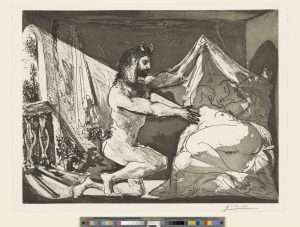
Faun uncovering a woman, 12 June 1936
© Succession Picasso/DACS, London 2024
This print from the Vollard Suite is a sugar
aquatint, scraper and engraving. The British
Museum acquired all 100 etchings from the
Vollard Suite (1930-37) in 2011 as a gift
from Hamish Parker and held an exhibition
in 2012. The current exhibition will show a
selection of his prints from the suite in the
context of his entire printmaking career,
showing the influence of classical art in the
1920s and 30s and the development of his
skills as a printmaker at this time.
Just as Rembrandt was a revered source for Picasso he also was for Goya too, who was in turn influenced by Rembrandt, long before Picasso was born. One of Goya’s La Tauromaquia is included in the present exhibition. Published in 1816 when the subject was not as politically sensitive as it is today, the bullfight was a favourite subject for Goya as it was for Picasso.

Pike II, 1959 © Succession Picasso/DACS, London 2024 Picasso focused on making linocuts from the
mid-1950s until around 1962. This coloured
example shows the artist’s continuing
interest in the theme of the bullfight.
But many of Goya’s Tauromaquia prints have been interpreted to have other political undertones, referring, for example, to the unpopular Joseph Bonaparte who had abdicated the Spanish throne three years before Goya’s prints were published. Thus aside from subject matter it links them in other ways to Picasso’s The Dream and Lie of Franco (plates I & II), 8, 9 January and 7 June 1937, that satirised Generalísimo Francisco Franco. Those prints were originally intended to be cut up and sold as postcards to raise funds for the Spanish Republican Government.
If Rembrandt’s deepest blacks were achieved by dense cross hatching, Picasso’s seem to have been achieved using sugar lift. The technique also allowed for more painterly effects, as a brush could be used to literally lift the layer of sugar employed. Picasso used it to great effect in his illustrations for the 18th century publication Histoire naturelle written by Georges-Louis Leclerc, Comte de Buffon. Commissioned by Vollard in 1936 Picasso evoked different textures for each of the thirty-one animals he illustrated. Later, in his 347 Suite, created between March 16 and October 8 1968, he would use the texture reticulation makes using sugar lift technique on a greased plate. Thus he evoked sumptuous brocades in his Meninas and gentlemen in the Sierra, 1 June 1968, and the wind tosses foliage of a tree in Tree in the storm, with flight towards a church, 15 August 1968. Using one material or texture to evoke another quite different was a feature he employed across his media.

Tree in the storm, with flight towards a
church, 15 August 1968
© Succession Picasso/DACS, London 2024
Sugar aquatint and drypoint on greased
plate. This print from the 347 Suite
demonstrates his playfulness with
printmaking at this time, the storytelling
element of the suite, and his experiments
with unusual techniques, such as greasing
the plate. Picasso: printmaker is the first time it will be displayed.
Another three-dimensional source included in the exhibition is a Grecian red and black amphora from 540 BCE showing Theseus slaying the Minotaur. The Louvre has an impressive collection of such pieces although this exhibit is from the British Museum’s collection. Its typically lustrous black clay contrasts with the matt terracotta of its design, just as Picasso employed this same contrast of surface sheen and flat lack of lustre in some of his black and red linocut prints. Thereby he conjured depth and movement without resorting to conventional perspective. But perhaps the most impressive part of Picasso’s linocuts is the forward planning they involved. His use of the reduction linocut technique allowed multicoloured prints to be made from a single block. As with his command of his lines and the thinking that must have involved, Picasso needed to know exactly what he wanted to achieve before even the first cut was made in the lino. There was no space for error, and he achieved this without any preparatory drawings or plans, working it all out in his head.

Still life under the lamp, 1962
© Succession Picasso/DACS, London 2024This colour linocut is considered to be one
of Picasso’s greatest achievements in linocut
printmaking. Picasso continued to
experiment with his printmaking, using the
‘reduction linocut’ technique, which
enabled him to print an image from one
block, cutting away at it in sections to print
each colour. The Museum holds a collection
of linocuts that demonstrate this technique,
most notably the proofs for each stage of
Still Life Under the Lamp. It is one of a group
of linocuts acquired by the BM in 2013.
Not included in the current exhibition is the way in which Picasso was able to take his printmaking beyond its own genre. Unlike many artists and the art world overall who divide art into different rigid genres of greater or lesser importance, Picasso crossed them. Fully aware of the sculptural qualities of his lino cut blocks, he had some cast in bronze, transforming them from being printing blocks with two-dimensional associations, into three-dimensional sculptures with connotations of public bronze monuments.
Thus to speak of Picasso’s printmaking is to refer to a very wide range of intertwined influences, periods, media, all of which he used to magically conjure images with rich associations. This is no small achievement.
Picasso Printmaker at The British Museum runs from 7 November 2024 to 30 March 2025, open daily: 10.00–17.00 (Fridays 20.30)
[1] Quoted in Marie-Laure Bernadac, ‘Picasso 1953 – 1972: Painting as Model’ in Late Picasso: Paintings, Sculpture, Drawings, Prints 1953 – 1972, London, Tate Publishing, 1988, pp. 49-94, at p.88, referred to in Catherine Daunt Picasso Printmaker, The British Museum, London, 2024, p. 24.
[2] P. 28